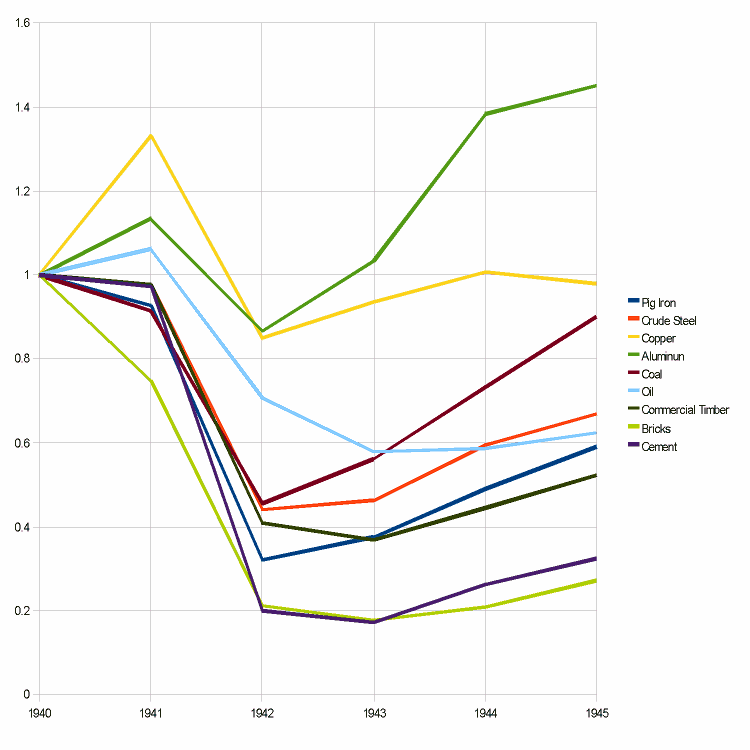
First, a specific claim you made, Iosef:
Iosef Cross wrote:They could also build a large oil stock in the 30's, before the war started. Oil was quite cheap in those days, and Germany could have imported oil and raw materials before the war started, to avoid the problems that ocurred historically.
Could you please show me some figures? But the oil issue isn't the really amazing one here. What really blew me away is that you said:
If Germany manages to defeat the USSR in 1941, they would have vast additional resources to pour on the Luftwaffe, the Navy and their superweapons programes, like development of nuclear weapons. These resources would be freed from the eastern front and also would represent the contributions of the vast natural resources available to Germany in this scenario, with would mean the increase in GDP for all occupied Europe.
It is not improbable that they would make a serious nuclear program with these additional resources, starting in late 1941, early 1942. Over 3 years before the first American nuke is tested.
...OK, even I can see the problems with this one.
"If Germany manages to defeat the USSR in 1941..."
How? Does this plan involve Soviet commissars shooting every single Russian and then shooting themselves? Because if the USSR doesn't conveniently commit suicide, there's no way for the German army to knock them out of the war in 1941. They might have gotten a little farther than they did, but you yourself point out that they couldn't have delivered much more in the way of firepower (tanks, planes, etc.) to the front than they did historically. Better tactics would not have gotten them much farther.
The Germans faced unavoidable constraints on operations: the autumn mud, the devastating winter, the fact that the Soviet railroad network was incompatible with German rolling stock while much of the Soviet rolling stock had been destroyed or evacuated in the fighting, and so forth. Therefore, even before you begin with the next sentence, this is already an absurd and impossible fantasy.
"...they would have vast additional resources to pour on the Luftwaffe, the Navy, and their superweapons programes [sic], like development of nuclear weapons..."
What you miss here is a key factor:
weapons development takes time. You cannot accelerate it indefinitely by throwing more money at it, and you certainly can't accelerate it by throwing more steel production or untrained manpower at it. The Germans were doing weapons R&D right up until March and April of 1945, by which point enemy troops were physically overrunning the labs and enemy bombers were forcing them to work in underground bunkers all the time. Do you really think they
needed high industrial output, or that it would have been helpful?
Regardless of how much money and labor goes into equipping the army, fighter jets still take years to design. The world isn't a hyper-simplistic economic fantasy; you don't just plunk down X dollars and get Y units of research delivered to your doorstep a week later.
"...These resources would be freed from the eastern front and also would represent the contributions of the vast natural resources available to Germany in this scenario, with would mean the increase in GDP for all occupied Europe..."
And this helps them develop advanced weapons how? They're still limited by the same political and technical problems: building a jet engine does not get easier when you capture the Baku oil fields, even if you have more fuel to feed those engines once you do build them. The Germans didn't start to get the hang of series production of jet engines until 1944-45, and even then they weren't very good at it. So how would such a program be accelerated by a sudden glut of raw materials and slave labor from Russia?
Well, not slave labor, because this scenario requires all Russians to commit suicide in 1941 to explain how the Germans suddenly overran Russia in six months. But now we get to the really daft part:
"...It is not improbable that they would make a serious nuclear program with these additional resources, starting in late 1941, early 1942. Over 3 years before the first American nuke is tested."
This is completely insane, for the following reasons:
1) The German nuclear program failed for reasons having
nothing at all to do with lack of funds. The scientists responsible for the very earliest stages of nuclear research (you know, the ones required to prove that a fission weapon can even be made) failed utterly. They made massive technical errors, feuded among themselves, and suffered from incompetent leadership.
Giving them more money would not make giving them money any less of a stupid waste of time, and therefore would not give the Germans a bomb any faster. To give the Germans a bomb fast, you'd basically need to have time travellers go back and explain to them that yes it IS possible and yes it IS a very effective weapon and no they should NOT do this, that, or the other thing and yes graphite IS a neutron moderator and so on.
2) Even if the German nuclear program was not led by idiots (it was), your assertion that they could have a bomb in 1942 is completely laughable. I imagine you've never been involved in scientific research, but when you've got a fundamental question to answer, you
cannot accelerate it past a certain point, even with unlimited resources. To develop the first nuclear weapon, a nation had to:
-Recognize that this was a possibility, and one of supreme importance, worth spending vast resources on abstract science and arcane engineering that would be useless for any other purpose.
-Design a working research fission reactor as proof-of-concept and for testing materials.
-Do extensive calculations modeling the subatomic physics behind nuclear reactions
-Do further extensive calculations modeling the behavior of various types of explosives.
-Devise entirely new techniques to separate isotopes in large quantities
-Implement those techniques, bearing in mind that if you do it wrong you're fucking around with fissile materials and they can go bang if you concentrate too much of them in one place
-Design a working bomb using high-precision explosive charges and the aforementioned fissile material
-Design an aircraft that can reliably deliver the bomb over the target (this is a nontrivial step, likely to prove as expensive as several of the others combined; compare the development costs on the B-29 to the cost of the Manhattan Project).
I suspect I missed a few steps; it doesn't really matter. The point remains that all these things are
prerequisites. Some of them are necessary conditions for later steps: you cannot possibly design a nuclear bomb without knowing the material properties of the things you build it out of.
Now, bear in mind that the two really critical physics questions here involve neutron absorption and fission. Fission was discovered in
1939; virtually nothing was known about it until the wartime bomb projects got a blank check to research it. You can't go from "nothing" to "we understand this" in six months, not in quantum physics.
Then there are engineering issues that revolve around neutron capture cross-sections and such.
The neutron was discovered in 1936, only six years before your proposed German bomb. Again, virtually nothing was known about how materials interacted with neutrons until wartime research using early atomic piles was performed.
The point being, we know how long it took to invent a nuclear bomb starting from nothing: about four or five years. This was in a country that had the pick of practically all the world's leading physicists (the Manhattan Project roster reads like a Who's Who of physics from 1925-1970). A country with enormous, unmatched industrial and financial resources that were completely immune to enemy attack. A country with an efficient, organized government that gave the program top priority and appointed brilliant administrators to run it.
So it is contemptibly foolish to propose that a nation with a smaller talent pool, fewer resources, and less efficient government management could do the same thing in
two years.
What were you thinking?