Constantinople,
Emperor Manuel II Palaiologos woke with a start. He had not slept well, probably because of the victory feast last night. The Emperor and Autocrat of the Romans was no longer a young man, and the wine had been both plentiful and strong. Shaking his head to clear the cobwebs, he shuddered at the memory of his dream: Constantinople besieged by Mongols, scheming nobles promising salvation in return for the end of Imperial authority, the Turks defeated and their lands occupied, leaving the Empire dangerously overextended and facing Mongols on one frontier and the Timurids on the other. Disturbing, to say the least.
Perhaps the nature of last night's celebration had contributed to the dream. A great victory had been won over the Turks, though they remained a formidable power; the Byzantine Navy had cut their forces in Asia off from their European territories and allowed the Emperor to extract considerable concessions from them, to the tune of most of their coastal territory.
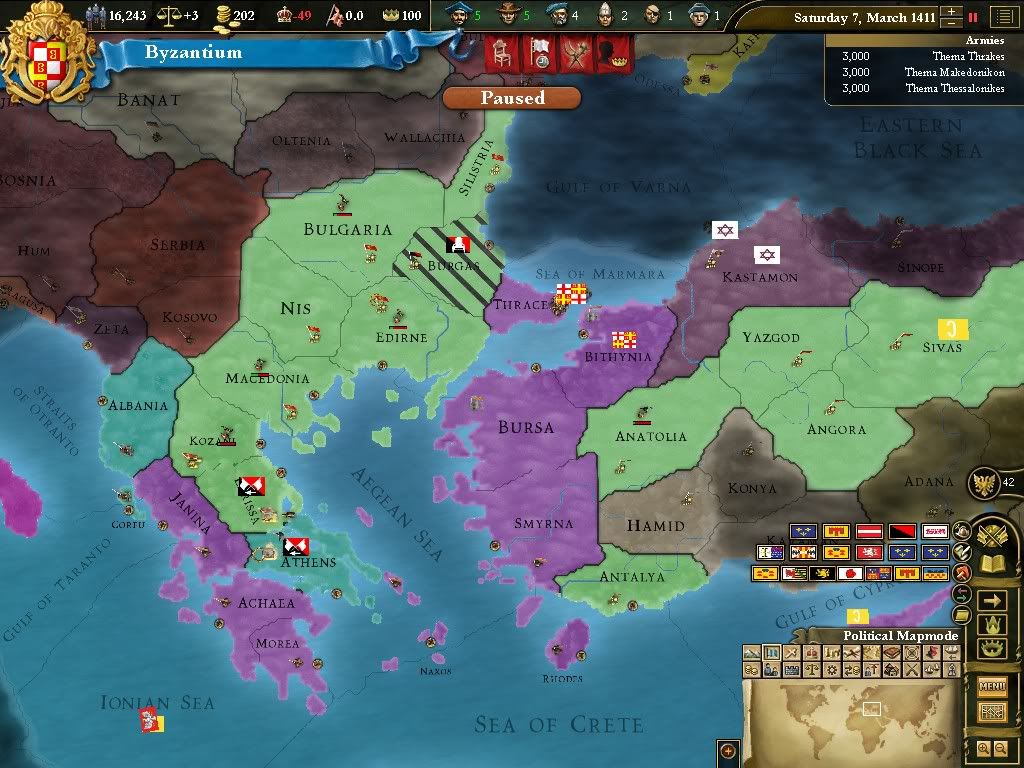
Inspired by the power of Byzantine arms (and by certain unaccountably similar-looking agents) Greek patriots had risen up in Venetian-occupied Athens and the Greek territory still under Turkish rule to try and rejoin the Empire. The Venetian and Turkish garrisons of the affected provinces had retreated to their citadels to await reinforcements which their mother countries were both too busy to send - Venice with its war against France, and the Ottomans with another Timurid invasion. Just as the Ottomans, with the aid of Mamluk cavalry sent to defend fellow Mohammedans had defeated the invaders, the Sultan died in his bed, leaving no clear heir: his younger cousin took the throne but certain high nobles refused to accept his claim and rose in revolt. Before long half the European territories were under rebel hands, though the Byzantine occupation of the coastal provinces kept the revolt from spreading to Asia. Byzantium looked fairly secure, especially once Athens and two of the remaining Greek-speaking Ottoman provinces succeeded in winning freedom for themselves and joined the Empire of their own free will.
So much was the power of the Empire grown from where it had been only a few years earlier that European nations began to take a greater interest in befriending Byzantium. Both Naples and Sicily signed treaties of alliance and sealed them with royal marriages - the Imperial heir Ionnes took Maria of Naples as his wife, and Sicily's king, whose previous wife had died, married one of the Emperor's daughters, a charming young woman named Helena. Things were looking up for the Empire - until the fateful day of 11 December 1416.
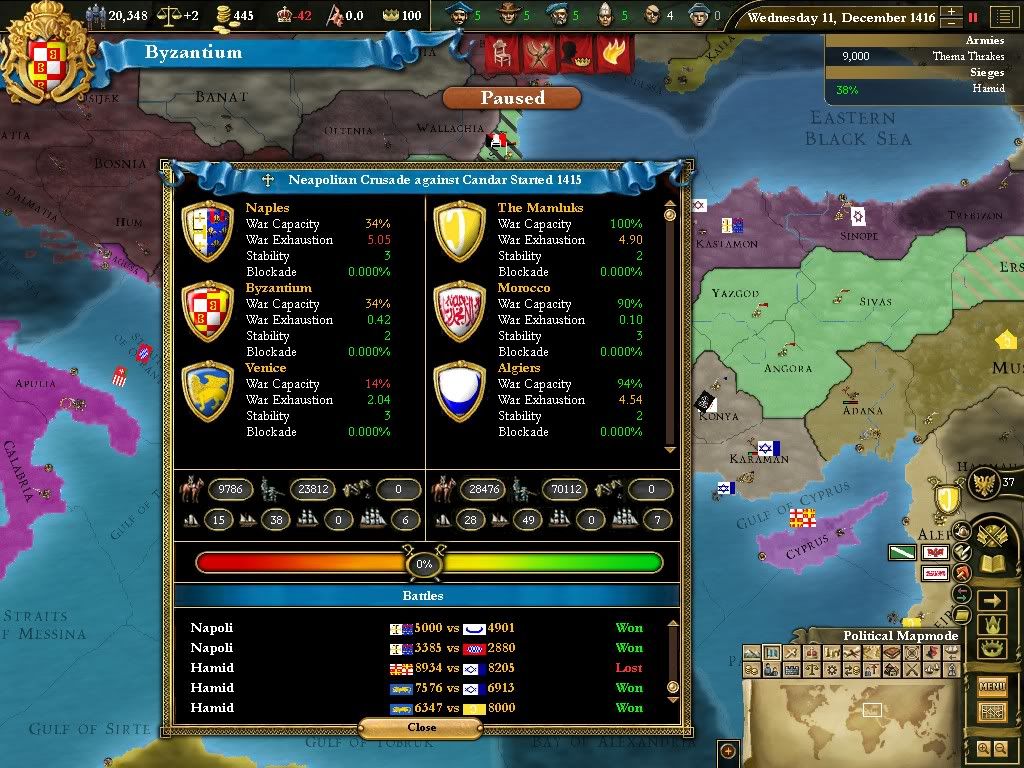
The Empire hated crusades. But the treaty of alliance with Naples demanded the Manuel lead his nation to war again, this time against what seemed like the entire massed might of the Muslim world. Algerian, Tunisian, and Mamluk pirates scoured the outer islands, forcing the Navy to hunt each individual ship down, an expensive and time-consuming prospect. While this was being done legions of Muslim soldiers were streaming into the newly-acquired provinces and laying siege to the garrisons. The small professional Army the Empire maintained was smashed at Hamid, but the brilliant general Elpidios Zarides escaped to Thrace and took command of fresh regiments as they arrived from Greece. The new Army was fresh and well-trained, and managed to stave off the occupation of the Asian territories, if only barely. After forcing it to abandon the siege of Bursa, Zarides himself led his cavalry on a daring pursuit of the Turkish army to ensure its destruction, realizing that if the Turks survived to reinforce the Mamluk forces coming up to the front, his troops would be destroyed. His constant attacks over the course of a month dispersed the Ottomans completely, and when the Mamluk armies arrived from Egypt they found Byzantium's troops well-rested, well-supplied, and ready to continue the war. The question of whether the 13,000-strong Thema Thrakes could have defeated the larger but tired from their long march Mamluk force was never answered, as Naples reached a peace treaty with the Muslims before the battle could begin. The war ended a day short of five years after it began, with no territory gained on either side and thousands of men from each nation involved dead.
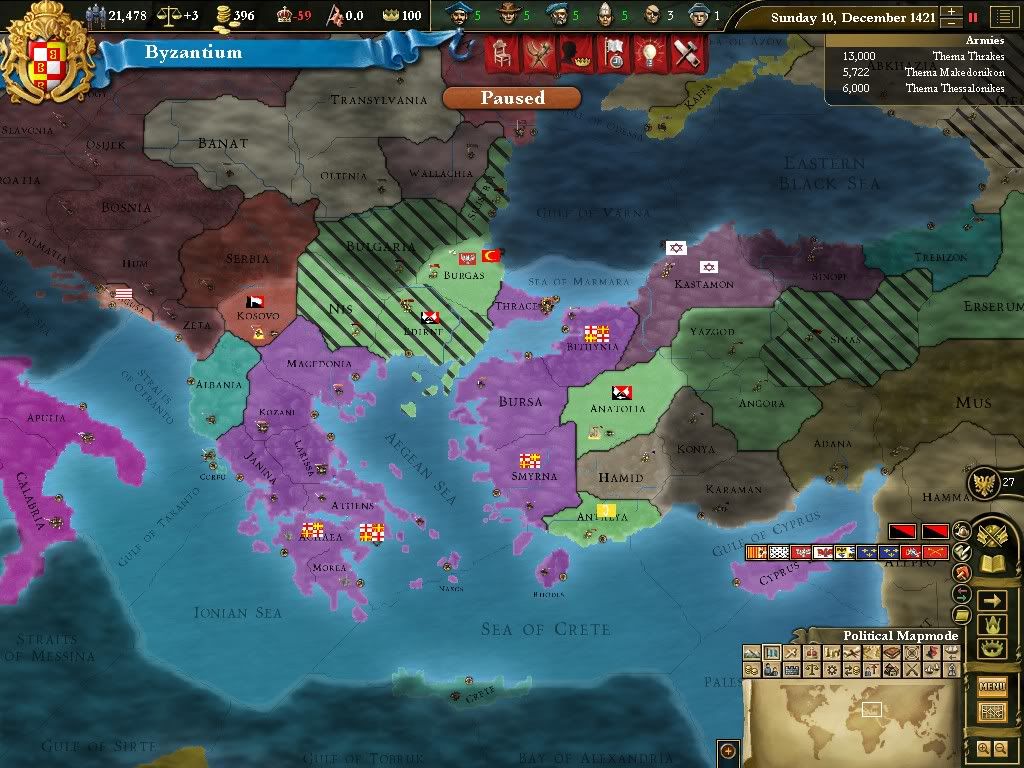
The Byzantine economy, at least, had profited from the war. Stronger relations with Naples and Sicily meant more trade, particularly in cloth and wine, allowing the Imperial government to collect enough taxes to turn a monthly profit for the first time in the Fifteenth Century. After decades of razor-thin budgets it was a welcome change, as were certain advances in the science of government.
OOC: We get out first National Idea! Explanation and list is
here, and we can build Churches now. They cost a fair bit (about as much as two regiments) but give a bonus to province stability, which we need right now. Or do we? Shall we keep the provinces in line through force or religion? I've got missionaries in the Turkish provinces we captured, trying to convert the Muslims to the One True Orthodox Faith, but until they succeed it'll be pretty unstable in Byzantine Asia.
Where to from here?